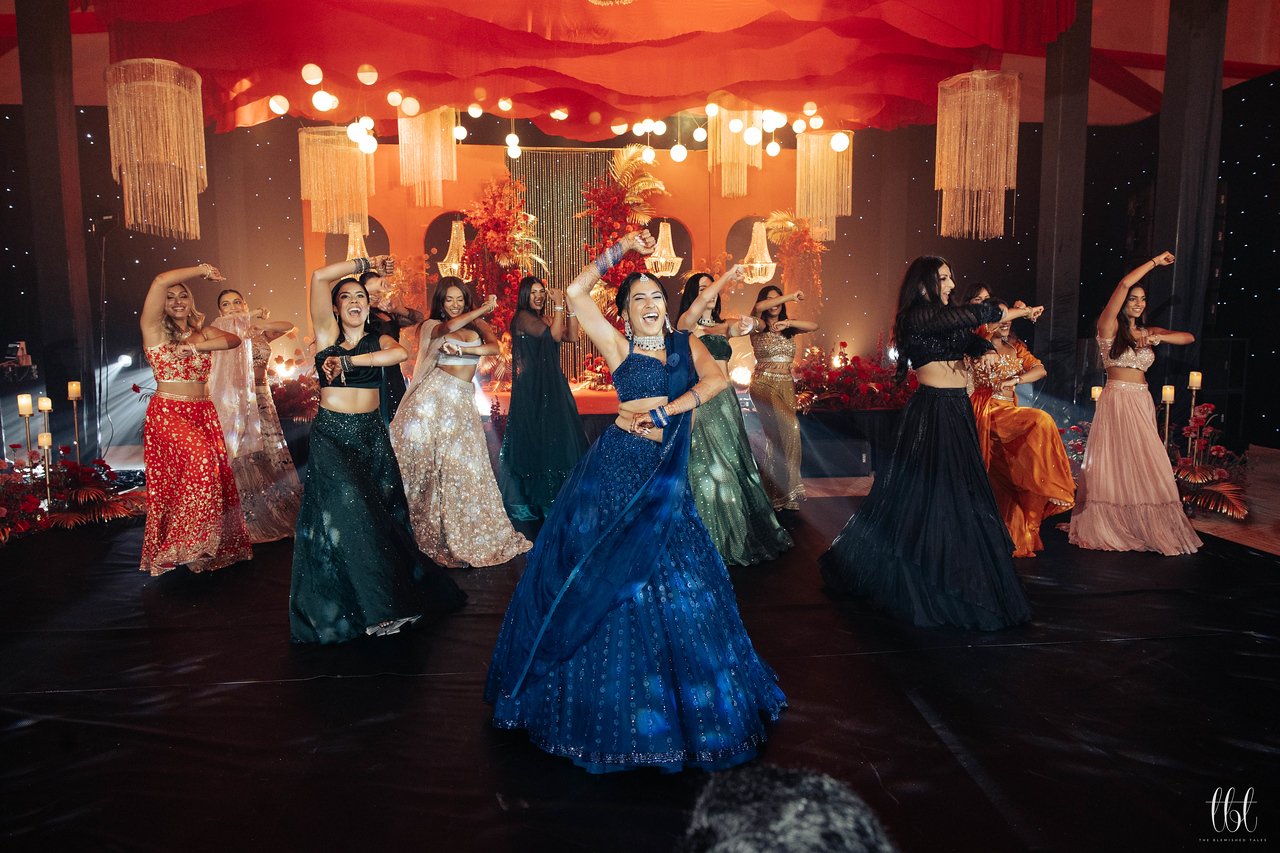
The sangeet is the music-and-dance night before an Indian wedding, and today it is usually a full evening of performances, dinner and dancing. With many performances, it can easily run long. A good sangeet comes down to a venue with a real stage and dance floor, a short list of rehearsed performances, dinner served on time, and a clear running order that the MC and DJ both hold.
What is a sangeet?
The word comes from Sanskrit and means "sung together". The sangeet began as a Punjabi and North Indian tradition.
- Traditionally, it was a small, women-only gathering at the bride's home a few days before the wedding. Women sat around a dholki drum, sang folk songs, from sad farewells to songs teasing the groom's family, and danced giddha.
- It once stretched over many days. Today it is one night, and it doubles as a chance for the two families to get to know each other.
- Today both families come, men and women alike. Expect choreographed dances, DJs, LED screens and stage sets. Some families fold in the jaago, a night procession with a lamp-lit pot.
- Related events. At many Pakistani and Muslim weddings, a dholki is a drum-led gathering held in the weeks before. At Gujarati weddings, the equivalent is a garba night, with circle dances around a lamp and dandiya raas with sticks.
When to hold it and how long it lasts
- Usually one or two days before the wedding, sometimes the night before. At a destination, many schedules put it on the evening of the second day.
- Plan for three to five hours. A typical evening runs from about 7 pm to 11 pm.
- Guest count: it varies. A typical sangeet has 150 to 250 guests, smaller than the reception, but for some families it is as large as the reception, or larger.
How to plan a sangeet, step by step
- Choose the venue for the stage and the floor. You need a large dance floor, a stage and strong sound. A stage and dance floor take space from seating, so ask the venue for a scaled floor plan. Check the stage size before you plan group routines: a small stage means smaller groups and shorter dances.
- Put the end time and sound limits in the contract. If the sangeet and another event share a room, ask whether the reset costs extra.
- Book the music. A DJ gives smooth transitions, and a live band gives a fuller sound. Many couples pair a DJ with a live dhol player.
- Choose the MC. Many sangeets use a professional emcee, often in Hindi or a regional language, though English or bilingual works. Others pick a confident, well-known family member.
- Cap the performances. Eight to ten acts at most, two to three minutes each, and merge groups if more people want in. Most songs need cutting to length.
- Set the order. A common order is children first, then friends, siblings, parents and elders, solos, and the couple last.
- Book a choreographer and rehearsals. Keep the steps simple, and hold a final rehearsal the day before, on the real stage if possible.
- Plan dinner. Serve a full dinner, and serve it by about 9 pm if elders or children are coming.
- Collect video messages early. Start about six weeks before.
- Plan outfits for dancing. Sangeet outfits are usually the brightest of the week, and they need to move. Some guests skip a saree because it restricts dancing.
A sample sangeet run of show
Here is a sample timing. Adjust it to your number of performances.
| Part of the evening | How long |
|---|---|
| Guests arrive, drinks and music, no performances | 45 to 60 minutes |
| Welcome from the MC | 5 minutes |
| First block of performances | 40 to 60 minutes |
| Dinner | 60 to 90 minutes |
| Second block of performances | 30 to 45 minutes |
| Video messages and speeches | 15 minutes |
| Open dance floor | Until the music cut-off |
With a 7 pm start and an 11 pm cut-off, trim the blocks so there is still time to dance.
Print the running order for the MC, the DJ and one person who is not performing. Name someone to get the next group ready, and feed the performers first.
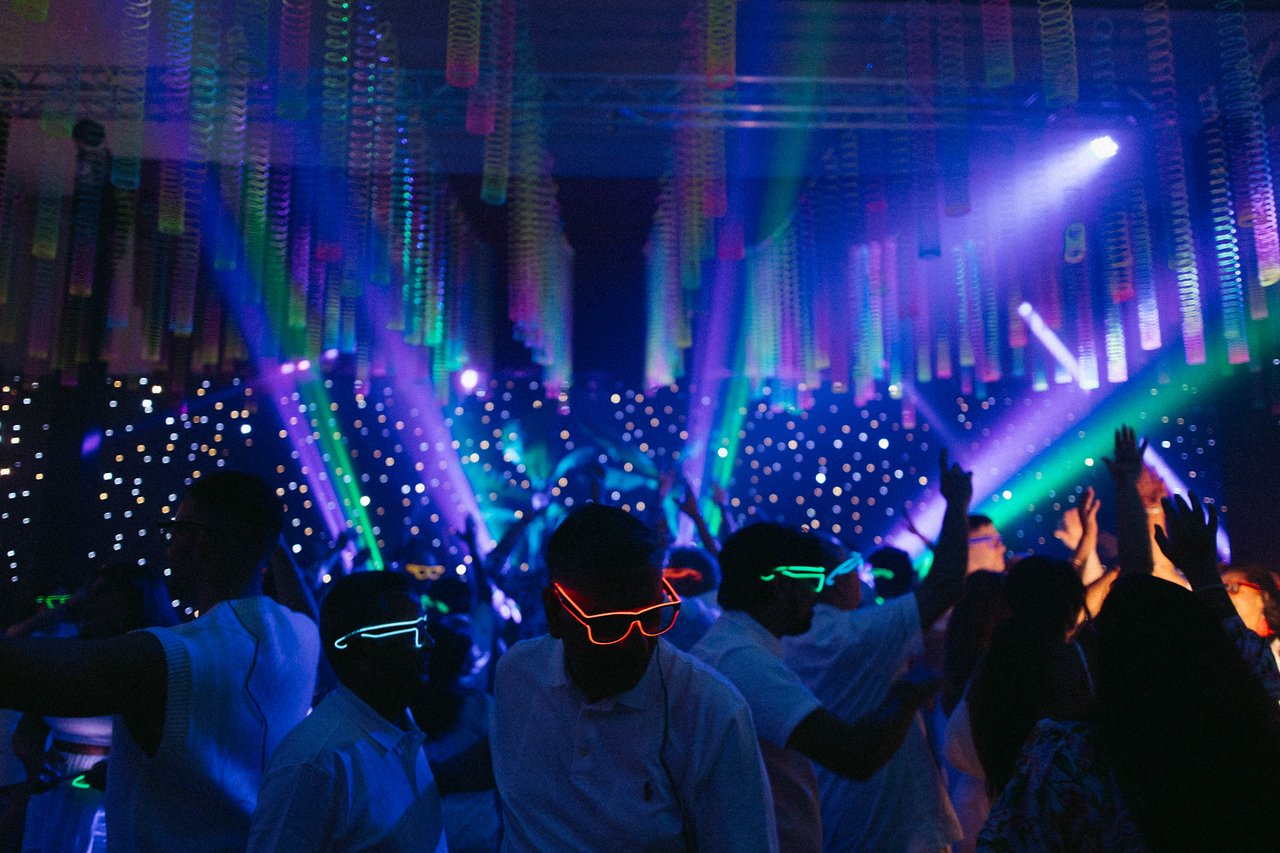 Photo by The Blemished Tales
What goes wrong at a sangeet
- The music has to stop. Resorts and hotels set cut-off times. At one Riviera Maya resort the music ends at 11 pm, and some resorts limit dhol drumming to before 10 pm. Ask before you plan the open dance floor.
- Too many acts. Too many or too-long performances drain the room. Keep the cap, and build slack into the schedule for overruns.
- The sound fails. Keep every track on one device in running order, with a backup, and keep one master song list so nobody dances to the same song twice.
- Dancers forget the steps or the order gets mixed up. Simple choreography and a final rehearsal fix most of it.
- There is nowhere to rehearse. At a destination, get rehearsal times and space from the venue in writing.
- The choreographer has to travel. Choreographers flown in for destination weddings are booked months ahead, so book early and budget for travel.
- Guests are confused about the schedule. Show each guest only the events they are invited to, and send updates to the right list.
Sangeet formats
- The performance night. Choreographed family dances, a stage, an MC and a dance floor afterwards.
- A combined mehndi and sangeet. Common at Punjabi weddings, and some resort packages bundle both into one four-hour event. It saves a day and money, but wet henna can stain outfits, smudge during couple dances and limit moves. Some guests skip it.
- A garba night, for Gujarati families, with garba and dandiya raas.
- A cocktail sangeet. A looser party, with a DJ mixing in traditional music and dance-offs between the families.
- A theme. Bollywood, Sufi, bhangra or retro.
What a sangeet costs
Costs depend on scope, so treat these as reference points.
- The whole sangeet: about $200 to $250 per guest in the US, or $60,000 to $75,000 for 300 guests. Catering alone can run about $80 per guest.
- DJ: about $800 to $1,600. DJ, sound, MC and lighting packages for a reception start from about $4,000.
- Dhol: about $800 to $1,200 per player.
- Choreography: about $650 to $1,200 for a couple's routine and $800 to $1,700 for a group routine, or from $95 an hour.
- At a destination resort: outside vendors, DJs included, often pay a fee, roughly $500 to $1,500 per vendor per event day, and an extra event space can cost $1,000 to $3,000. One Cancun resort's Indian wedding package, which includes a three-hour sangeet with dinner and bar, costs $9,900 for 50 guests and $14,900 for 100.
- Decor extras: a dance floor wrap can cost $3,000 to $4,000.
A sangeet checklist
The full, printable version sorts every step by when it needs doing: download the sangeet checklist (PDF) or open it on the site.
- Book a venue with a real stage and dance floor, and get the music cut-off in writing.
- Book the DJ or band, dhol, lighting and an MC.
- Cap performances at eight to ten, two to three minutes each.
- Schedule rehearsals, including a final one on the real stage.
- Serve dinner by about 9 pm.
- Print the running order for the MC and DJ.
Where DoDeewane fits
We make DoDeewane, a planning tool for multi-day Indian weddings. The sangeet is where a multi-day plan is tested hardest: a dozen performances, a DJ, a dhol player, a photographer and a venue with a cut-off, all on one evening.
- One run of show. The sangeet's timings, performance order and dinner sit on the same timeline as every other function, and every vendor sees the same version.
- Entertainment line-ups tied to the run of show. Performances, the DJ's sets and the dhol entry are planned against the schedule, not in a separate spreadsheet.
- Gaps show up early. A DJ or photographer whose contracted hours end before the dance floor does is flagged weeks ahead.
- Contracts are read for you. Upload the venue and vendor contracts, and overtime rates, outside-vendor fees and payment dates go into the budget.
- Its own guest list. Invite the right people to the sangeet, and the headcount for dinner follows the RSVPs.
- Outfits planned per function, so everyone's sangeet outfit is sorted with the rest of the week.
We are admitting ten founding couples with weddings after April 2027.
Sign up to receive an invitationMore on wedding functions
Frequently asked questions
What is a sangeet?
A music-and-dance night before an Indian wedding. It began as a Punjabi and North Indian women's gathering of folk songs around a dholki drum, and today both families come for performances, dinner and dancing.
How long does a sangeet last?
Usually three to five hours, for example 7 pm to 11 pm, including dinner and an open dance floor.
How many performances should a sangeet have?
Eight to ten at most, two to three minutes each. Merge groups if more people want to perform.
Is the sangeet before or after the mehndi?
It varies by family. One common order is the mehndi, then the sangeet, then the haldi and the wedding. Some families hold the sangeet first, and some combine the mehndi and sangeet into one event.
Who hosts the sangeet?
Traditionally it was held at the bride's home and organised by the women of both families. Today both families usually take part, and many couples hire a professional MC.